

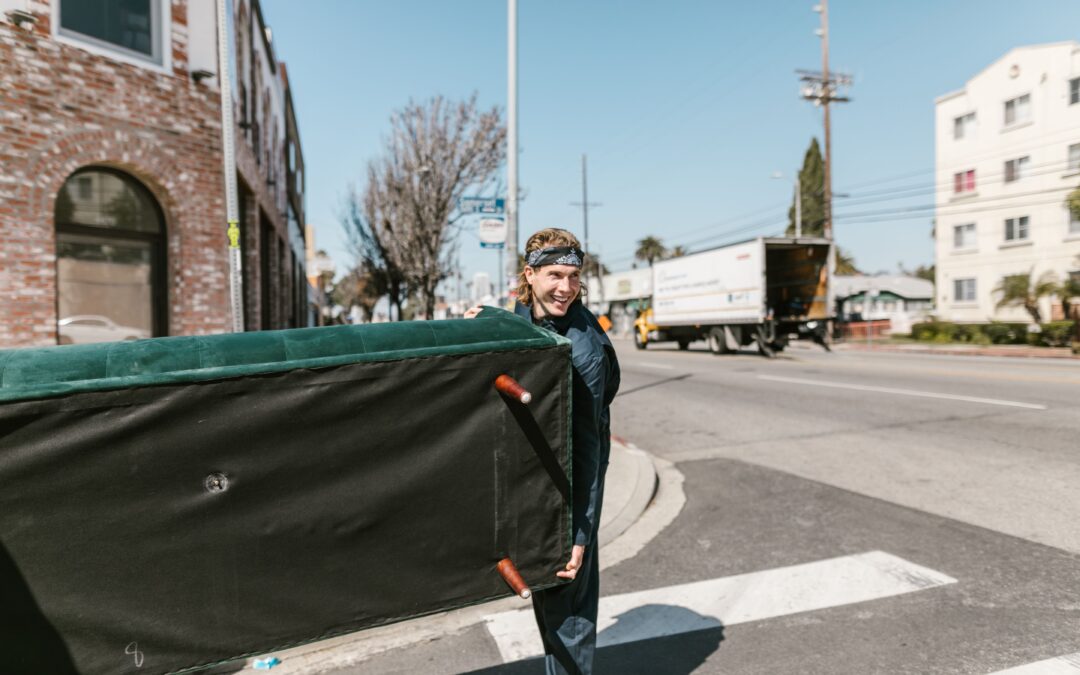
Every move starts with the same argument at the kitchen table: rent a truck and do it ourselves, or pay professionals to handle it? One side says movers are a luxury. The other side remembers what happened to their back last time.
Opinions are everywhere. Actual numbers are not. So we ran them. We priced out three realistic moving scenarios both ways, with every cost included. Not just the rental fee on the website banner, but the kilometre charges, the fuel, the insurance you'll be offered at the counter, the equipment rentals, the pizza for your friends, and the costs nobody puts in a spreadsheet until it's too late.
Here's the math, so you don't have to do it.
The short answer
For a studio or one-bedroom local move, renting a truck usually wins, often by $250 to $450. For a full household or any long-distance move, the gap shrinks fast once you add fuel, mileage, equipment, and hired loading help. At that point, professional movers frequently come out as the better value per dollar of stress. The crossover point sits somewhere around a two-bedroom home.
Now let's open the spreadsheet.
Scenario 1: Studio or one-bedroom, local move (~20 km)
This is the move people picture when they say "we'll just rent a truck." A few rooms of furniture, mostly boxes, and one trip if you load smart.
The DIY version:
| Cost item | Typical range (CAD) |
| 15-foot truck, one-day rental | $30-$50 base |
| Kilometre charges | $50-$90 |
| Fuel | $30-$50 |
| Damage waiver / insurance | $20-$35 |
| Dolly and furniture pad rentals | $25-$40 |
| Pizza and drinks for two friends | $50 |
| Total | $205-$315 |
The professional version: two movers and a truck for three to four hours at $130-$170 per hour comes to roughly $430-$760 including a standard tip.
Verdict: DIY wins, and it's not close. If your furniture survived three previous moves, your building has an elevator, and you have friends who still answer texts about moving day, rent the truck.

Scenario 2: Three-bedroom house, local move
Here's where the napkin math starts lying to people. A full household doesn't fit in one trip of a 15-footer, and it doesn't get loaded by two friends in an afternoon.
The DIY version:
| Cost item | Typical range (CAD) |
| 26-foot truck, full day (often two) | $60-$120 |
| Kilometre charges, multiple trips | $80-$150 |
| Fuel (loaded 26-footers are thirsty) | $60-$100 |
| Insurance / damage waiver | $30-$60 |
| Dollies, pads, straps | $50-$80 |
| Two hired labourers, 6 hours each | $480-$720 |
| Food and incidentals | $80 |
| Total | $840-$1,310 |
The professional version: three movers and a truck for six to eight hours at $170-$230 per hour lands around $1,080-$1,960 with tips.
Verdict: DIY still looks $300-$600 cheaper on paper. But look at where the DIY money goes. More than half of it is already paying people to move you. At this point you're not really saving on movers. You're saving a few hundred dollars in exchange for being the project manager, the truck driver, and the insurance policy for your own belongings. This is the crossover zone. If anything you own is heavy, fragile, or expensive (and in a three-bedroom house, something is), a professional residential moving crew starts winning on value, not just convenience.
Scenario 3: Long-distance move (450 km, e.g. Lower Mainland to the Interior)
Long-distance is where both columns get expensive and the risks stop being theoretical.
The DIY version:
| Cost item | Typical range (CAD) |
| 26-foot truck, one-way, 2-3 days | $400-$700 |
| Kilometre overages | $150-$400 |
| Fuel for 450 loaded kilometres | $200-$300 |
| Insurance | $60-$120 |
| Equipment rentals | $50-$80 |
| Meals and a hotel en route | $100-$200 |
| Loading and unloading help, both ends | $500-$900 |
| Total | $1,460-$2,700 |
The professional version: a full-service long-distance move for a three-bedroom home typically quotes at $2,100-$4,650 depending on weight and route.
Verdict: DIY can still save real money here, but this is also where DIY risk peaks. You're piloting an unfamiliar 26-foot vehicle through mountain highways, you're personally liable for everything inside it, and one damaged appliance or one missed ferry can erase the savings in an afternoon. Before assuming DIY wins, get binding quotes from at least three companies. For lighter loads, the gap is often far smaller than people expect.
The costs nobody puts in the spreadsheet
The tables above are the visible math. The invisible math decides more moves than people admit.
Your time. A DIY three-bedroom move consumes a full weekend, plus the evenings of packing before it. Value your hours at anything above zero and the "savings" thin out quickly.
Your body. Professional crews are trained, equipped, and covered by workers' compensation. Your lower back is covered by ibuprofen.
Liability. Drop one end of a dresser through the drywall of a home you just sold, and that repair is yours. Reputable movers carry cargo and liability insurance for exactly these moments.
Specialty items. Pianos, gym equipment, antiques, and glass furniture are where DIY moves go to die. There's a reason piano moving is its own profession.
Timing gaps. If your possession dates don't line up, a rental truck becomes a very expensive storage unit parked on the street. Short-term storage between moves is almost always cheaper and far more secure.
Availability. On month-end and summer weekends, rental trucks sell out across the Lower Mainland. A confirmed mover booking is a guarantee. A truck reservation is closer to a suggestion.
So which should you choose?
Rent a truck if: the move is local and small, you genuinely have helpers, the budget is the only number that matters, and nothing you own would make you wince if it hit the pavement.
Hire movers if: you have a two-bedroom home or larger, specialty items, stairs at either end, a long-distance route, or a tight timeline. The same goes if you'd simply rather spend the weekend unpacking instead of recovering. For most moves in this category, a local moving crew costs less than people fear and saves more than they expect.
Costs and logistics also shift city by city. Parking permits, elevator bookings, and truck availability are their own puzzle in a dense market. If you're weighing the decision specifically in the Lower Mainland, our guide to moving truck rental vs. hiring movers in Vancouver covers the local details.
Frequently Asked Questions
Is it actually cheaper to rent a truck than hire movers?
For small local moves, almost always. Expect savings of $250-$450 for a one-bedroom. For full households, the savings shrink to a few hundred dollars once you add equipment, fuel, and hired labour. For long-distance moves, the gap depends heavily on weight and route. Run the full numbers, not just the rental rate.
How much does it really cost to rent a moving truck for a day?
The advertised base rate ($30-$120) is rarely what you pay. After kilometre charges, fuel, insurance, and equipment rentals, a realistic one-day local total is $200-$400 for a small move and $800 or more for a large one with hired help.
How much do professional movers cost per hour?
In BC, expect roughly $130-$170 per hour for a two-person crew with a truck, and $170-$230 per hour for three movers. Most one-bedroom local moves take three to four hours. A three-bedroom home takes six to eight.
What's the biggest hidden cost of a DIY move?
Labour and liability. Hired loading help at both ends of a move runs $500-$900 on its own. Beyond that, any damage to your belongings, the truck, or either property is entirely your responsibility, and rental damage waivers cover far less than people assume.
When are movers clearly worth it?
Any move involving a piano or other specialty items, stairs, long distances, misaligned possession dates, or a household larger than two bedrooms. In those cases the price difference buys you insurance, speed, and an intact spine.
Skip the spreadsheet and get the real number
You've seen our math. Now get yours. A free estimate from Smoother Movers takes two minutes, costs nothing, and gives you an exact figure to weigh against your DIY budget. If the rental truck still wins for your move, we'll be the first to tell you. For most households, though, the real quote is smaller than the guess. Request your free estimate or contact our team today, and spend moving day supervising with a coffee instead of carrying a couch.